
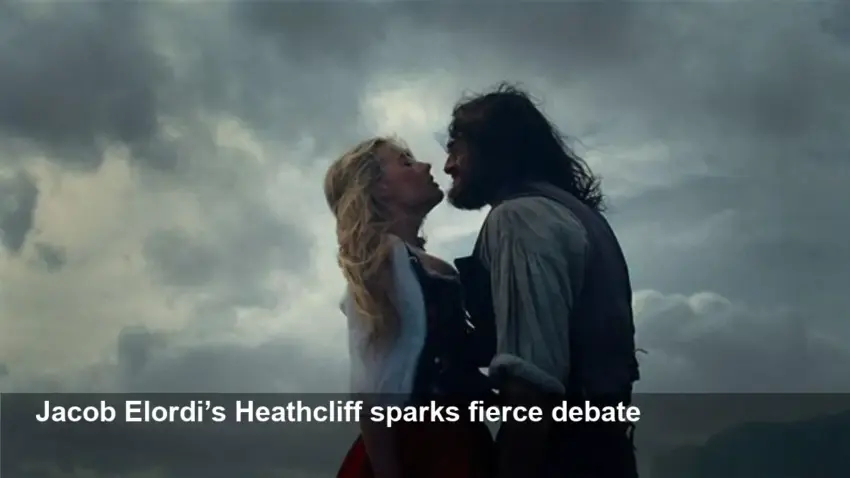
- Casting of Jacob Elordi as Heathcliff and Margot Robbie as Cathy has triggered a fierce online backlash.
- Critics cite whitewashing, age and anachronistic styling as core complaints.
- Director Emerald Fennell’s provocative tone and past films intensified scrutiny.
- Early screenings and a steamy trailer have amplified divided reactions.
Why Jacob Elordi became the center of the storm
Jacob Elordi’s casting as Heathcliff in Emerald Fennell’s new Wuthering Heights quickly became the most visible flashpoint in a wider cultural debate. Fans and critics object to Elordi’s look and ethnicity in a role that many readers interpret as explicitly non-white in Emily Brontë’s text, and they’ve also flagged the age gap between the actors and the novel’s teenage protagonists.
Elordi, best known for his roles in Euphoria and other contemporary hits, appears in a film that leans into erotic, modernized visuals — a directorial choice that has intensified questions about fidelity to the source material.
Casting, whitewashing and age concerns
The complaint most often repeated online is whitewashing. Heathcliff in the novel is described as having a darker complexion and being treated as an “outsider.” Critics argue that casting the Australian-born Elordi — who is white-presenting — misses an opportunity to reflect that aspect of the character and the story’s social dynamics.
Age is another point of friction. In the novel, Cathy and Heathcliff are teenagers during their formative relationship. Margot Robbie and Jacob Elordi are adults in their 30s and late 20s respectively, a choice that many say changes the story’s balance and emotional stakes.
Trailer reaction and test screening fallout
A trailer released ahead of the film’s wide release amplified the debate. It shows overtly sensual imagery, anachronistic costume choices, and a modern soundtrack — all unmistakably Emerald Fennell in tone. Early test screenings were reported to be chilly, with some viewers calling the adaptation salacious and emotionally blunt.
Embedded trailer (YouTube): https://www.youtube.com/watch?v=3fLCdIYShEQ
That clip went viral: commenters mocked modern hair and teeth, debated the wedding dress and riffed on the film’s aggressive stylization. For supporters, the trailer signalled a bold reimagining; for detractors, it felt like a provocation.
Context: Fennell’s track record and fan devotion to the book
Part of the backlash stems from Fennell’s reputation. Her previous films, Promising Young Woman and Saltburn, split critics with their audacious visuals and sharp satire. Some audiences already viewed Fennell as inclined toward style-over-substance, priming them to dislike her Brontë adaptation from the outset.
Equally important is how fiercely readers protect Wuthering Heights. Many fans internalize the novel during adolescence; changes to beloved character details or tone often read as an affront to personal memory and identity.
Where things stand now
Expectations remain polarized. Some reviewers from early press screenings praised the film as a daring, modern classic; others find it disrespectful to Brontë’s social nuances. Jacob Elordi’s casting will likely continue to dominate conversations as the film reaches wider audiences, underscoring how casting choices can become cultural flashpoints in adaptations.
Whether Fennell’s Wuthering Heights will be judged a successful reinvention or a misstep, the controversy has already guaranteed it a prominent place in this year’s film conversation.
Image Referance: https://www.bbc.com/culture/article/20260205-how-wuthering-heights-became-this-years-most-divisive-film