
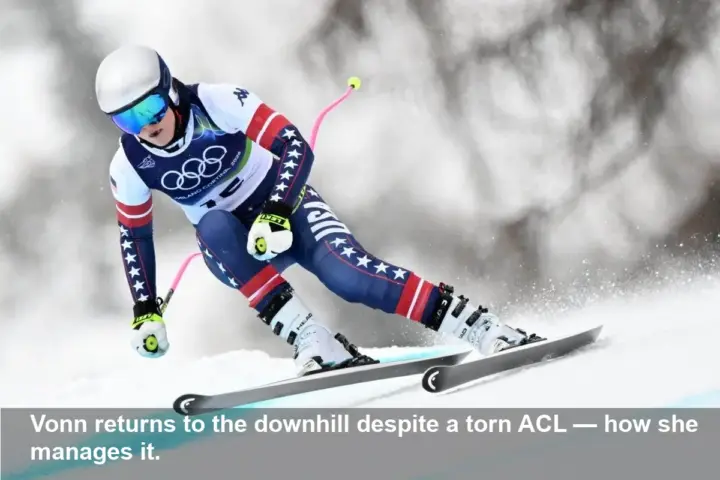
• Lindsey Vonn is racing the Olympic downhill despite a ruptured ACL, after completing training runs in Cortina.
• A rare combination of low swelling, a high-tech brace, strong muscles and skiing mechanics makes it possible.
• Experts say downhill’s steady, predictable movements and equipment reduce knee stress compared with pivot sports.
• Vonn’s experience, body awareness and targeted compensation (landing more on her uninjured leg) help her manage the risk.
H2: Why this seems impossible — and why it’s happening
Lindsey Vonn’s return to downhill racing days after an anterior cruciate ligament (ACL) rupture has stunned fans. ACL tears typically sideline elite athletes for many months. Yet Vonn completed multiple training runs in Cortina d’Ampezzo and is entered in the Olympic women’s downhill.
Medical specialists point to a mix of biological, equipment and sport-specific factors that make her presence on the start gate feasible — though still extraordinary.
H3: Low swelling and compensating structures
A key reason Vonn can move is that her knee has not swollen to the degree that usually follows a first-time ACL tear. Less swelling means the joint remains more functional and easier to stabilize. Experts also note other knee ligaments and surrounding soft tissue can compensate, at least short term, for the loss of ACL restraint.
H3: Muscle strength, body awareness and experience
Vonn brings exceptional quadriceps, hamstring and glute strength and decades of body-awareness at high speed. Those muscles can actively hold the tibia and femur in alignment when the ACL is not functioning. At 41, her experience helps her anticipate landings and shifts in pressure in ways younger athletes might not.
H2: Equipment and the nature of downhill skiing matter
Skiing’s gear plays a protective role. Stiff ski boots limit ankle motion and reduce torque transmitted to the knee. Bindings and the boot–binding interface also help maintain alignment. Vonn uses a modern, functional ACL brace that adds external stability and confidence.
Unlike sports such as soccer or basketball, downhill alpine racing is classified as a lower-level pivoting sport. Racers lean forward and follow a predictable line downhill rather than making repeated, sharp plant-and-cut moves. That steadier, flowing motion recruits the muscles best equipped to substitute for an ACL’s stabilizing role.
H3: Tactical adjustments on the course
Coaches have observed Vonn favoring her right (uninjured) leg on some landings to reduce load on the injured knee. While this can cause occasional bobbles — especially when a ski lands on edge — it is a deliberate tactic to minimize strain.
H2: Risks and realities
Physicians caution this is not a routine choice. Compensating with other ligaments and muscles can increase wear elsewhere in the knee over time. The absence of swelling now does not guarantee a longer-term pain-free outcome. Still, sources close to Vonn’s team emphasize careful monitoring, pain and swelling control, and the use of brace and rehab techniques to keep her functional.
H3: What experts say
Sports-medicine specialists say the combination of limited swelling, muscular compensation, a brace, ski equipment and Vonn’s elite timing and experience make this rare feat possible. But they underscore that most athletes with ACL ruptures cannot safely return to high-speed competition so quickly.
Bottom line: Lindsey Vonn’s decision to race on a torn ACL highlights how sport mechanics, modern bracing and elite conditioning can align to make an otherwise career-stopping injury temporarily manageable — and why it remains an exceptional scenario, not a new norm.
Image Referance: https://www.nytimes.com/athletic/7028848/2026/02/07/lindsey-vonn-torn-acl-winter-olympics-explained/