
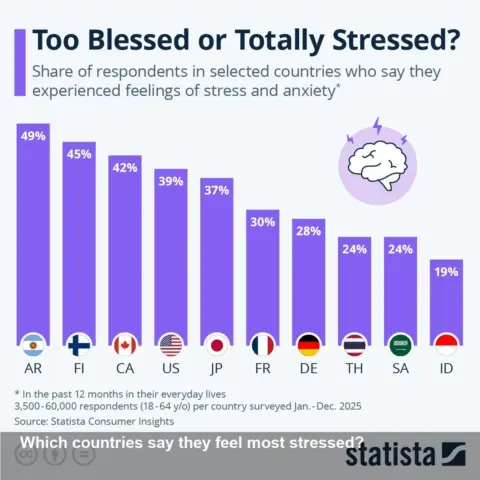
- Statista published an infographic comparing the share of respondents in selected countries who reported feelings of stress and anxiety.
- The chart highlights clear international differences: some countries report much higher shares of stressed respondents than others.
- The data offers a quick visual snapshot useful for researchers, policymakers and mental-health professionals.
- You can view and share the original Statista chart via the links below.
H2: What the Statista infographic shows
Statista’s chart, titled “Too Blessed or Totally Stressed?”, visualizes survey responses from selected countries about whether people experienced feelings of stress and anxiety. The graphic reports the share of respondents in each country who said they had felt stressed or anxious, providing a side-by-side comparison that makes differences between countries easy to spot.
The piece is presented as an infographic for quick consumption: color-coded bars and a compact layout let readers scan which countries reported higher or lower shares of stress. The chart does not include full methodology details in the snapshot, so readers who need sample sizes, survey dates or weighting should consult Statista’s full chart page for those specifics.
H3: Why the differences matter
Cross-country comparisons of reported stress and anxiety help identify where mental-health pressures appear more prevalent and where public-health interventions might be prioritized. They also point to wider social, economic and cultural factors that can shape how people perceive and report stress — for example, economic uncertainty, work-life balance, social support systems and access to mental-health services.
While the infographic itself focuses on headline shares rather than deep causal analysis, it can be a valuable starting point for journalists, researchers and policymakers who want to explore potential drivers behind the variation and track trends over time.
H4: How to view the original chart and share it
You can view Statista’s full infographic and additional context on Statista’s site. Statista includes sharing tools so readers can post the chart to social media directly. Official share links from the chart page:
- Facebook: https://www.facebook.com/sharer/sharer.php?u=https%3A%2F%2Fwww.statista.com%2Fchart%2F35801%2Fshare-of-respondents-who-experienced-stress-anxiety%2F
- X (Twitter): https://twitter.com/intent/tweet?text=Too%20Blessed%20or%20Totally%20Stressed%3F&url=https%3A%2F%2Fwww.statista.com%2Fchart%2F35801%2Fshare-of-respondents-who-experienced-stress-anxiety%2F
- LinkedIn: http://www.linkedin.com/shareArticle?url=https%3A%2F%2Fwww.statista.com%2Fchart%2F35801%2Fshare-of-respondents-who-experienced-stress-anxiety%2F
H3: Takeaways for readers
The Statista infographic delivers a concise, visual snapshot of how reported stress and anxiety vary across countries. It’s a useful primer for anyone tracking global mental-health trends, but it should be read alongside the original Statista entry to check survey details and methodology before drawing firm conclusions.
If you use the chart in reporting or analysis, link back to Statista for the full context and to respect the source’s data attribution.
Image Referance: https://www.statista.com/chart/35801/share-of-respondents-who-experienced-stress-anxiety/