
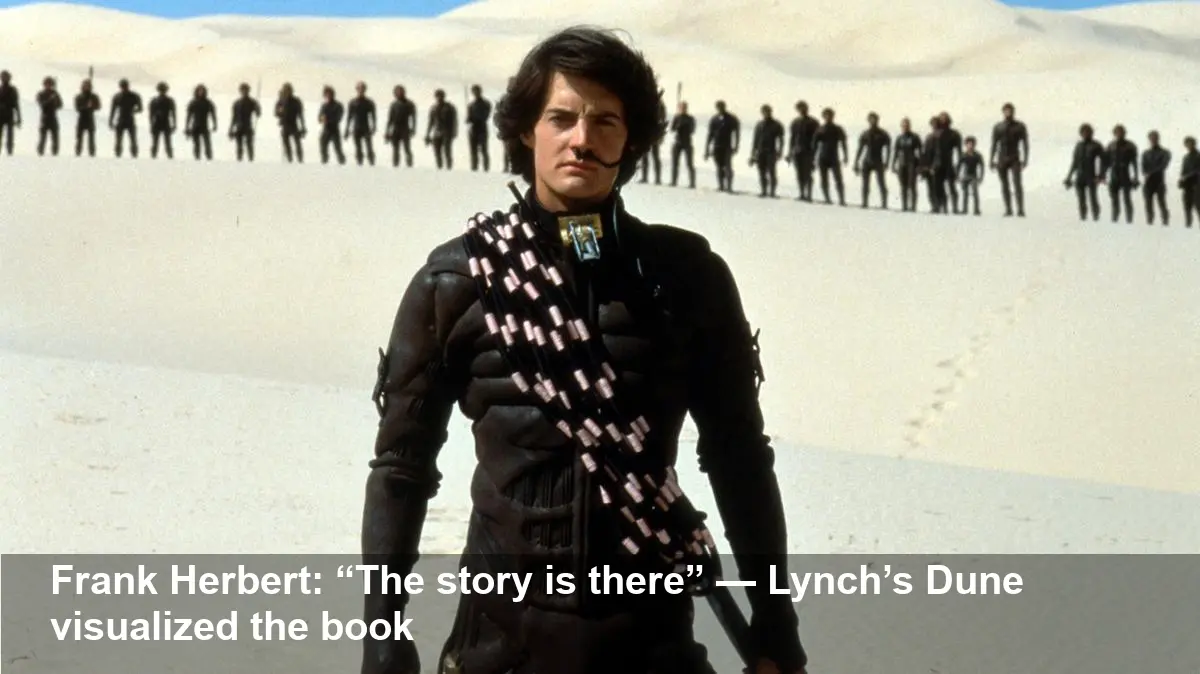
- Frank Herbert publicly praised David Lynch’s 1984 Dune adaptation, saying “the story is there.”
- Herbert liked Lynch’s visual approach and credited production design for improving the book’s look.
- He wished one sequence—the political banquet—had been included, but accepted film constraints.
- Lynch’s Dune remains a divisive, visually striking adaptation despite poor reviews and box-office returns.
H2: Herbert’s unexpected approval of Lynch’s Dune
When David Lynch’s Dune opened in 1984 it was widely criticized and struggled at the box office. Yet Frank Herbert, author of the original Dune novels, offered a surprisingly positive public response. Speaking around the film’s release, Herbert told Entertainment Tonight that, for him, the essential element was preserved: “The story is there. They saved the story. It’s all there. That’s what the author worries about.”
H3: What Herbert praised
Herbert praised Lynch and the film’s production team for translating his book’s strange, textured world into vivid cinematic imagery. He singled out the visual work—crediting director Lynch and production designer Anthony Masters—for bringing a heightened visual language to the material. “Why wouldn’t they improve on the visual sense of the film? And they have free license to do this. This is what film is all about,” Herbert said.
Short paragraphs, strong visuals
Lynch’s Dune stands out for its bold, often bizarre visuals that match the novel’s off-kilter tone. From the look of the Guild navigators to the desert landscapes, the film leans into surreal design choices that many viewers found compelling even if the narrative coherence was questioned.
H2: The missing banquet scene and narrative trade-offs
Herbert did note one key omission: a banquet scene that distills much of the novel’s political subtext. He understood why it was cut—time constraints and story economy—but pointed out that the sequence would have added political depth and clarified character motivations. That decision highlights a common adaptation trade-off: what serves a page-turning novel doesn’t always fit a two-hour film.
H3: Faithfulness vs. interpretation
Herbert’s reaction is notable because authors often react negatively to adaptations that simplify or alter themes. Lynch’s Dune streamlines the novel’s warnings about messianic leaders and moral ambiguity, presenting Paul Atreides more straightforwardly as a heroic figure. Herbert seemed willing to accept those interpretive choices as part of filmmaking.
H2: Legacy of Lynch’s Dune
David Lynch himself later spoke openly about his frustrations making Dune, and over time the movie gathered a reputation as both a flawed adaptation and an intriguingly singular work of cinema. Herbert’s pragmatic praise reframes the film: not as a definitive Dune, but as a creative, visually arresting interpretation that preserved the core story.
Final takeaway
Frank Herbert’s endorsement—limited but genuine—underscores a useful perspective on adaptations: fidelity matters, but so does the new language a filmmaker brings. Lynch’s Dune remains divisive, but Herbert’s comments remind fans that an author’s approval can come from seeing the spirit of a novel survive even when the details change.
Image Referance: https://www.slashfilm.com/2045599/dune-author-frank-herbert-david-lynch-movie-feelings/