
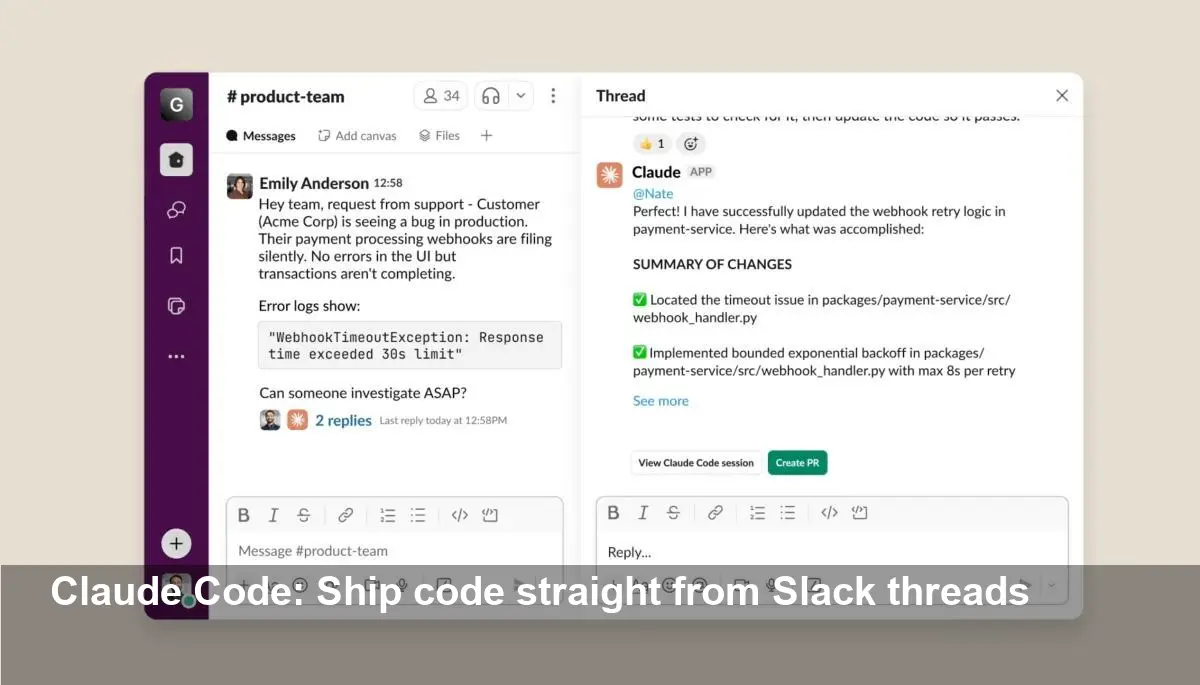
- Anthropic is rolling out Claude Code in Slack as a research-preview beta, enabling developers to delegate coding tasks directly from chat threads.
- Claude Code scans conversation context to pick repositories, run coding sessions, post progress updates, and link to pull requests.
- The integration shifts AI coding from IDEs into collaboration tools, but raises security, access and dependency concerns.
H2: What Claude Code brings to Slack
Anthropic’s Claude Code expands its existing Slack integration by adding full workflow automation. Instead of only getting snippets, explanations or debugging help in a chat, teams can now tag @Claude to spin up a complete coding session informed by the thread. The assistant analyzes recent messages — such as bug reports or feature requests — selects the likely repository, writes code, posts progress updates in the thread and shares links to code reviews and pull requests.
H3: How it works in practice
In the beta research preview, developers can start a task from a thread and watch Claude post status updates as it works. The assistant attempts to identify the correct codebase from context and deliver a patch that teammates can review without switching apps. That friction-free handoff — from conversation to code to PR — is the core value proposition Anthropic is betting on.
H2: Why this matters for developer workflows
AI coding assistants have traditionally lived in IDEs; moving them into Slack changes the locus of activity. Slack is already the hub for engineering communication, and embedding an “agentic” coding assistant there means teams can convert intent (a bug or request) into implemented code faster. Competitors are racing to do the same: Cursor and GitHub Copilot offer Slack or chat-based features, and OpenAI technologies can be exposed via custom bots. The race is shifting from raw model capability to integration depth and distribution.
H3: Strategic implications
Whichever AI tool becomes the default in collaboration platforms like Slack can shape how engineering teams organize work. If Claude Code proves reliable, teams may rely more on chat-driven development, reducing context switching and accelerating small fixes and reviews.
H2: Risks, security and governance
Anthropic and Slack have not announced a broad rollout date. The integration does, however, raise important questions. Giving an external AI service access to repositories introduces code-security and intellectual property concerns. Teams will need fine-grained access controls, auditing, and monitoring to ensure sensitive data isn’t exposed. There’s also operational risk: outages or rate limits in Slack or Claude’s API could disrupt workflows that were previously managed locally.
H3: What’s next
Anthropic’s decision to launch Claude Code in Slack as a research preview highlights the company’s focus on real-world developer workflows. Observers should watch for wider availability, enterprise controls, and audit tools. For now, Claude Code represents a clear shift: the next frontier for AI coding assistants is not just smarter models but embedding those assistants where teams actually collaborate.
Author: Tech news summary based on reporting by Rebecca Bellan. Date: December 8, 2025.
Image Referance: https://techcrunch.com/2025/12/08/claude-code-is-coming-to-slack-and-thats-a-bigger-deal-than-it-sounds/