
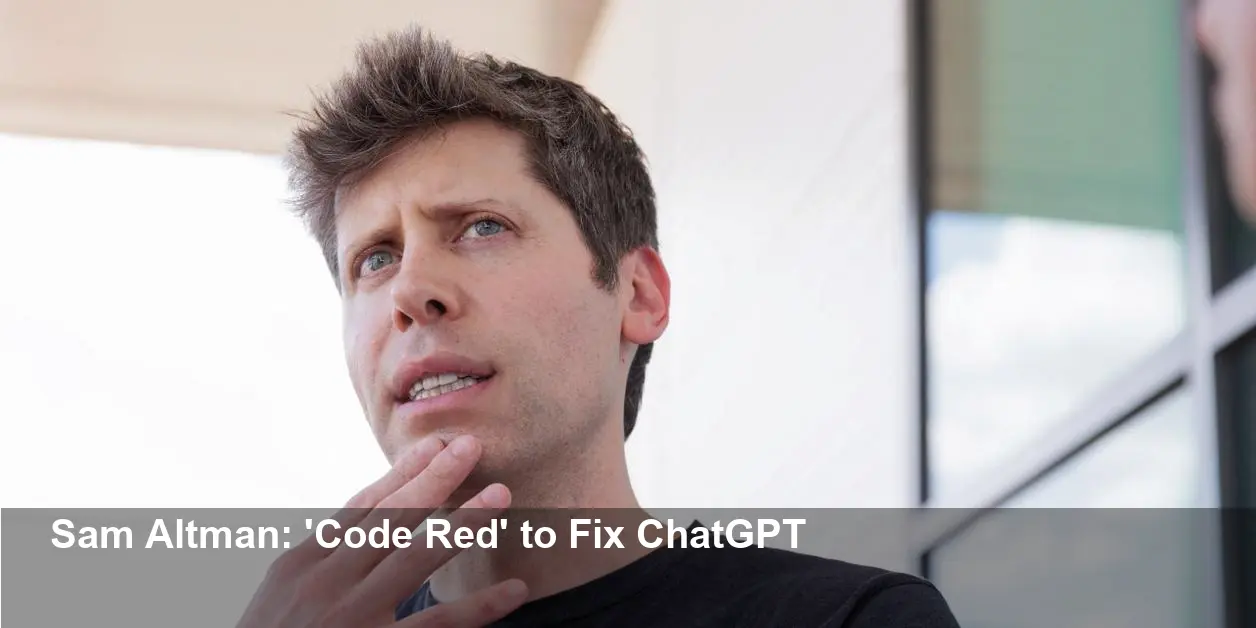
- Sam Altman told employees OpenAI is in a companywide “code red” to improve ChatGPT.
- The memo says the focus will be on speed, reliability, personalization and broader answers.
- OpenAI will delay other product work as it prioritizes day‑to‑day ChatGPT quality.
- The move reflects mounting pressure from competitors, notably Google, in the AI race.
H2: Sam Altman calls a “code red”
OpenAI Chief Executive Sam Altman told staff in a companywide memo that the company is declaring a “code red” to improve ChatGPT. According to the memo, the effort will prioritize the chatbot’s day‑to‑day experience — including personalization, speed, reliability and the ability to answer a wider range of questions.
H3: What the code red means for product priorities
Altman said teams will focus on immediate user experience improvements and delay other product work. That shift means engineering and product resources will be redirected to make ChatGPT feel faster and more dependable for everyday use, and to enhance how the model adapts to individual users.
Short, targeted changes are expected rather than new flagship features. The memo signals a tactical pivot: rather than pushing ahead quickly with new launches, OpenAI will concentrate on tightening the core experience of its widely used chatbot.
H3: Competitive pressure from Google and others
The internal alert is the clearest sign yet of the pressure OpenAI faces as rivals advance their own AI offerings. The memo framed the effort as a response to growing competition — most notably from Google — that threatens to erode OpenAI’s lead in generative AI.
By highlighting speed, reliability and breadth of answers, OpenAI aims to shore up the product areas that most directly affect everyday users and customer satisfaction — metrics that could influence adoption as competitors bring new capabilities to market.
H4: What users can expect
Users may see iterative improvements to ChatGPT in coming weeks and months: faster response times, fewer interruptions or errors, and more personalized interactions that remember preferences or context better. The company’s decision to hold back on some new products suggests updates will focus on refinement and stability.
H4: Why this matters
In a fast‑moving AI market, perceptions of quality and reliability can shift user loyalty quickly. Sam Altman’s “code red” memo underscores how high the stakes are for OpenAI: maintaining day‑to‑day excellence is now framed as essential to preserving its lead.
H5: The takeaway
OpenAI’s internal shift signals a pragmatic response to competition. Instead of racing only on features, the company is prioritizing fundamentals that shape user experience — a move that could determine how the next phase of the AI rivalry unfolds.
Image Referance: https://www.wsj.com/tech/ai/openais-altman-declares-code-red-to-improve-chatgpt-as-google-threatens-ai-lead-7faf5ea6?gaa_at=eafs&gaa_n=AWEtsqcQkBNmYlhgUTd1xtkdpn08JBlToDiTLTKY8nlZSK3wYYs14h0c6Hmk&gaa_ts=6937c502&gaa_sig=xcfg6UXlKM-nY7AjJsnXCQPSNjn05J1gUnT1vCWMa9htvsV5Ta_EcQ-emNCR_RCDAeemfoZVUfIkMTXprlc8pA%3D%3D