
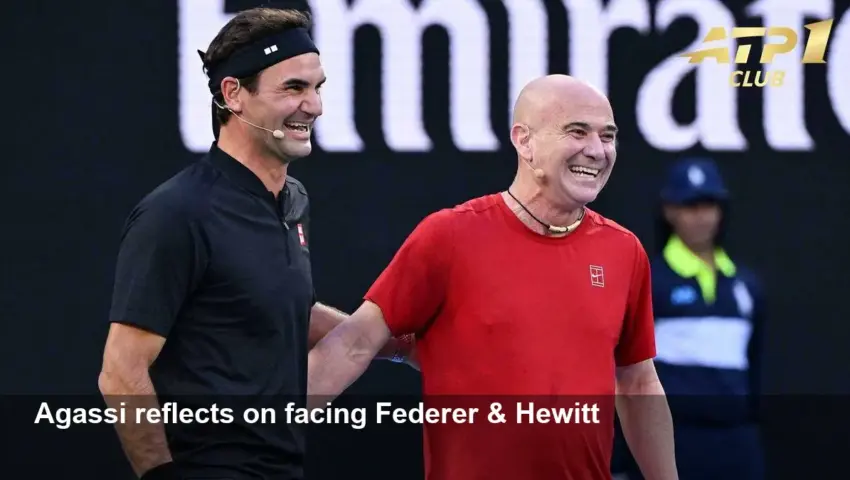
- Andre Agassi praised Roger Federer’s timing and Lleyton Hewitt’s defence-into-offence after a star-studded Australian Open doubles exhibition.
- Agassi said Hewitt’s transition game turned defence into attack; Federer’s pace control made opponents hesitate.
- The exhibition paired Federer, Hewitt, Agassi and Patrick Rafter, highlighting the ATP No. 1 Club’s enduring appeal.
- Agassi also reflected on his head-to-head records and the era of dominant No. 1s.
Exhibition sparks fresh reflections
Andre Agassi was part of one of the evening’s most talked-about moments at the Australian Open: a fun doubles exhibition alongside Roger Federer, Lleyton Hewitt and Patrick Rafter. After the match, Agassi stayed in analyst mode, offering candid praise for two of his toughest rivals.
“This was about watching different ways of being No. 1,” Agassi said. His comments came as much from respect as from experience — Agassi, Federer and Hewitt all sit in the ATP No. 1 Club and defined eras of men’s tennis.
H2: Hewitt’s defence turned into offence
Agassi singled out Hewitt’s ability to turn defence into attack. “I watched Lleyton do it. He turned a transition game phenomenally. He turned defence into offense,” Agassi said.
He pointed to Hewitt’s speed and relentlessness, noting that fast players could remain effectively on defence while still dictating play. Those traits made Hewitt a nightmare on hard courts and a player who could grind opponents down until they made errors.
H2: Federer — when time seemed to stop
Agassi’s tone shifted when he spoke about Roger Federer. He described playing Federer as a unique challenge: “You hit the ball and it leaves your racquet exactly how you want it, yet he has all the time in the world.”
Agassi explained that Federer’s blend of timing, variety and court geometry forced opponents into indecision. Federer could change pace, redirect the ball and move rivals “north and south, east and west,” Agassi said — a style that felt like the next generation pressing forward.
H3: Numbers that underline the era
Agassi and Hewitt split their head-to-head at 4–4, with all eight meetings on hard courts. Agassi trailed Federer 3–8. Their careers overlapped in a period of shifting power at the top of the rankings: Federer would go on to spend a record 310 weeks as world No. 1 (including 237 consecutive weeks), Hewitt held the top spot for 80 weeks, and Agassi spent 101 weeks as No. 1.
Those figures highlight how each player brought something different to dominate at various times — from Hewitt’s grit to Federer’s artistry and Agassi’s baseline mastery.
H4: Legacy on show in Melbourne
The exhibition in Melbourne was as much celebration as competition. Seeing former champions on court together served as a reminder of their different strengths and the small margins that separate great from greatest.
Agassi’s reflections were straightforward and revealing: great No. 1s don’t just win — they bring singular skills that force opponents to adapt. For fans at the Australian Open, it was a rare chance to watch those skills collide and to hear one legend explain how another made him feel on court.
Image Referance: https://www.atptour.com/en/news/agassi-on-federer-and-hewitt-australian-open-2026