
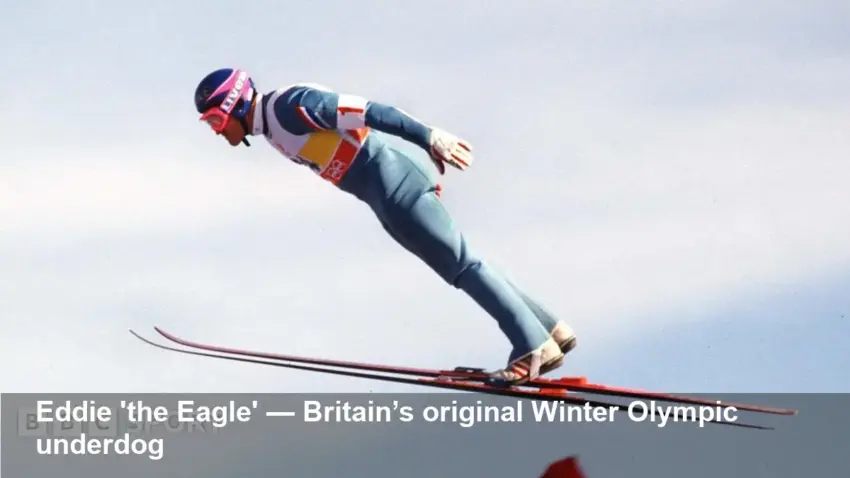
- Eddie “the Eagle” Edwards qualified for the 1988 Calgary Winter Olympics after only 22 months in ski jumping.
- He self-funded his training, slept in a cow shed in Lake Placid and competed in borrowed kit.
- Edwards finished last in both Olympic events but became a global cult hero and inspired a 2016 film.
- Listen to his full account on BBC Sport’s Greatest Underdogs podcast.
From Gloucestershire hills to the Olympic ramps
Michael “Eddie” Edwards grew up in Cheltenham and fell for snow sports at the Gloucestershire Ski Centre. After three one-hour lessons he was hooked. By his early 20s he had raced in Alpine skiing and slalom, but rising costs pushed him toward ski jumping — a sport he says cost him roughly £3.50 a day compared with £200 for alpine racing.
A rapid rise: 22 months to an Olympic Games
Edwards began power-jumping just under two years before the 1988 Winter Olympics. The British Ski Federation set a qualification benchmark — land 50 metres in a World Cup event — and Edwards met the challenge. He entered his first World Cup just 10 months after first stepping in power-jumping skis, despite only having done two jumps from a 120m hill prior.
His progress stunned sceptics. Where coaches expected short distances, he kept pushing from 30m up to 100m. Five weeks before Calgary he finally received the official letter: he was going to the Games.
The Calgary experience and the glasses that became iconic
At Calgary, Edwards became Britain’s first Olympic ski jumper. He competed in both the 70m and 90m events and finished last in each. But his distinctive look — thick prescription glasses worn beneath goggles — and his never-say-die approach made him a crowd favourite.
He has said his glasses steamed up on around 30% of his jumps, leaving him briefly unable to see. “I could just make out which way up I was looking from the snow and the blue sky,” he told BBC Sport. On some larger jumps he even managed to wipe the lens mid-flight.
A self-funded underdog, and a lasting legacy
With no federation funding, Edwards often trained and travelled in second-hand equipment. He has recounted periods of extreme hardship — once sleeping in a cow shed and scavenging food while training in Lake Placid. Those struggles only increased public affection when his Olympic story became widely known.
Although his Olympic results were not competitive, Eddie “the Eagle” became a household name. His life later inspired the 2016 film Eddie the Eagle and cemented his place in popular culture as one of sport’s most enduring underdogs.
Hear it in his own words
Listen to Eddie’s full telling on BBC Sport’s Greatest Underdogs podcast: https://www.bbc.com/sounds/play/p0lt0lmv
Read more about his early hardships in training here: https://www.bbc.com/news/articles/c4gj7p814gro
Eddie’s story is a reminder that Olympic legacy is not measured only in medals, but in courage, personality and the willingness to defy expectations.
Image Referance: https://www.bbc.com/sport/articles/c8rm8zp2n0po