
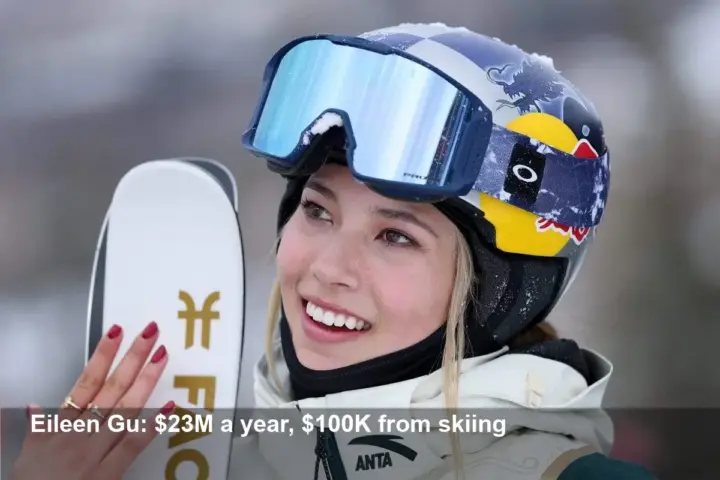
- Eileen Gu earned an estimated $23.1 million in 2025, but only about $100,000 came from competitive skiing.
- The 22-year-old’s income is driven almost entirely by endorsements across China and the West.
- Her China–U.S. background, social following and fashion work make her unusually marketable.
H2: Eileen Gu’s earnings — big off the slopes
Freestyle skier Eileen Gu, who won multiple medals at the Beijing 2022 Olympics, reported an estimated $23.1 million in earnings last year — yet only about $100,000 of that total came from skiing. Forbes places her among the highest-paid female athletes worldwide, largely because of lucrative brand deals rather than prize money or competition income.
H3: Why endorsements dwarf competition pay
Gu’s commercial appeal spans luxury fashion, sports and consumer brands. She models for and works with companies such as Porsche, Red Bull, IWC Schaffhausen, Anta Sports, Bosideng and TCL. She has appeared on magazine covers in China, walked for high-profile fashion houses and modeled for outlets including Victoria’s Secret and Louis Vuitton.
Those deals — and her selective, high-value portfolio — account for the vast majority of her income. In sports where prize money is limited, long-term sponsorships and brand partnerships can far exceed on-field earnings; Gu is a strong example of that trend.
H3: East–west crossover increases value
Gu was born in San Francisco and began her competitive career representing the U.S. before choosing to compete for China in 2019. That dual-market story makes her attractive to Western luxury names and major Chinese brands. Her social reach reflects that split: she has millions of followers on Weibo and Douyin, and a substantial Instagram audience.
That cross-border reach gives brands access to two of the world’s largest consumer markets through one public figure — an advantage that helps explain the size and scale of her endorsement deals.
H2: Public profile, scrutiny and resilience
The decision to represent China drew public debate and criticism in the U.S., and she has also faced scrutiny in China. Gu has publicly defended her choices — noting her competitive record for China, coaching contributions and donations to the national program.
Embedded post: The Burnouts podcast clip where Gu discussed criticism is available on YouTube — https://www.youtube.com/watch?v=5sPAyKrk0-s
H3: Athlete first — medals still matter
Despite the business side of her career, Gu continues to compete at the highest level. She remains among the most successful freeskiers in World Cup competition and is defending Olympic titles in big air and halfpipe.
Her public image mixes elite athleticism with fashion and lifestyle content — mirror selfies and journal posts sit alongside Sports Illustrated and Vogue features — which makes her relatable to younger audiences and valuable to marketers.
H2: What this means for sport and sponsorship
Gu’s situation highlights how modern athletes — especially women in certain sports — can build sizable incomes through cross-industry branding. If she stopped competing tomorrow, experts believe her public profile would likely retain significant commercial value. For skiing, it shows the growing gap between competitive pay and sponsorship-driven earnings.
H4: Follow-up links
Weibo: https://weibo.com/u/3639470012
TIME interview: https://time.com/7355691/eileen-gu-interview-2026-olympics/
New York Times background: https://www.nytimes.com/2022/02/03/sports/olympics/eileen-gu-china-freeski.html
Eileen Gu remains a top competitor and one of the best examples of how global endorsements can transform an athlete’s earnings profile.
Image Referance: https://www.nytimes.com/athletic/7003969/2026/02/05/eileen-gu-winter-olympics-23million/