
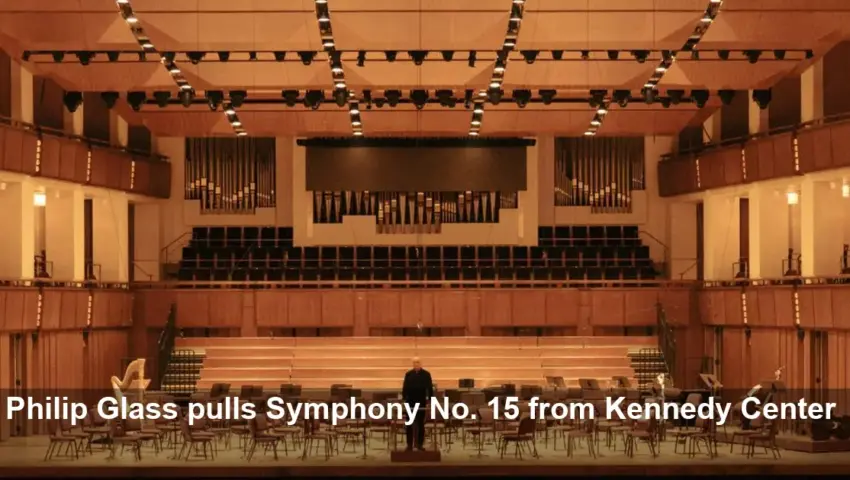
- Philip Glass has asked the Kennedy Center not to perform his Symphony No. 15, citing a conflict with the center’s values.
- The National Symphony Orchestra says it will continue its season despite cancellations and shrinking audiences.
- Conductor Gianandrea Noseda acknowledged the difficulty: “I cannot make everybody happy.”
- Other artists, including Renée Fleming, and the Washington National Opera have also pulled back from the center.
H2: Philip Glass withdraws Symphony No. 15
Philip Glass, 88, has informed the Kennedy Center that he does not want his Symphony No. 15 performed there. The work — a portrait of Abraham Lincoln rooted in Lincoln’s 1838 Lyceum Address — was commissioned by the National Symphony Orchestra and slated for a world premiere in June. In a letter shared with news outlets, Glass wrote that the “values of Kennedy Center today are in direct conflict with the message of the symphony,” and asked the institution not to stage the piece.
H2: How the orchestra is responding
The withdrawal is the latest setback for the National Symphony Orchestra, which has already faced falling ticket sales and high-profile cancellations. Gianandrea Noseda, the orchestra’s music director, acknowledged the controversy and the impossibility of pleasing everyone. “I cannot make everybody happy,” he told reporters as the orchestra pledged to continue programming and performances.
Joan Bialek, chair of the orchestra’s board, said the institution is determined to survive. “I was born in Washington, grew up with the Kennedy Center, grew up in the N.S.O., and I can’t let it disappear. We will make it through this,” she said, underscoring the board’s commitment to maintain operations and community engagement.
H3: Broader fallout at the Kennedy Center
Glass’s decision follows cancellations by other leading artists, including soprano Renée Fleming, and a public split with the Washington National Opera, which has moved productions out of the Kennedy Center. Those departures have deepened concerns about the institution’s stability and reputation within the arts community as it navigates leadership and political controversies.
H4: Why Symphony No. 15 mattered
Commissioned for the Kennedy Center’s 50th anniversary, Glass’s Symphony No. 15 was conceived as an homage to Lincoln and to civic values. The piece missed an earlier deadline but had been scheduled to debut this summer. Glass, a 2018 Kennedy Center Honors recipient, has long been a prominent figure in contemporary music; his withdrawal underscores the tensions between artists and cultural institutions in the current climate.
H3: What comes next
The National Symphony Orchestra says it will press ahead with its season and look for ways to engage audiences and artists. For the Kennedy Center, the loss poses programming and public-relations challenges: organizers must find replacements and reassure patrons and performers. Whether Glass’s symphony will be premiered elsewhere or rescheduled remains unclear.
The episode highlights a wider question facing major cultural institutions: how to balance artistic missions, donor relationships and public scrutiny while retaining the trust of creators and audiences. For now, the National Symphony is vowing continuity amid a period of uncertainty.
Image Referance: https://www.nytimes.com/2026/01/27/arts/music/kennedy-center-national-symphony-orchestra-gianandrea-noseda.html