
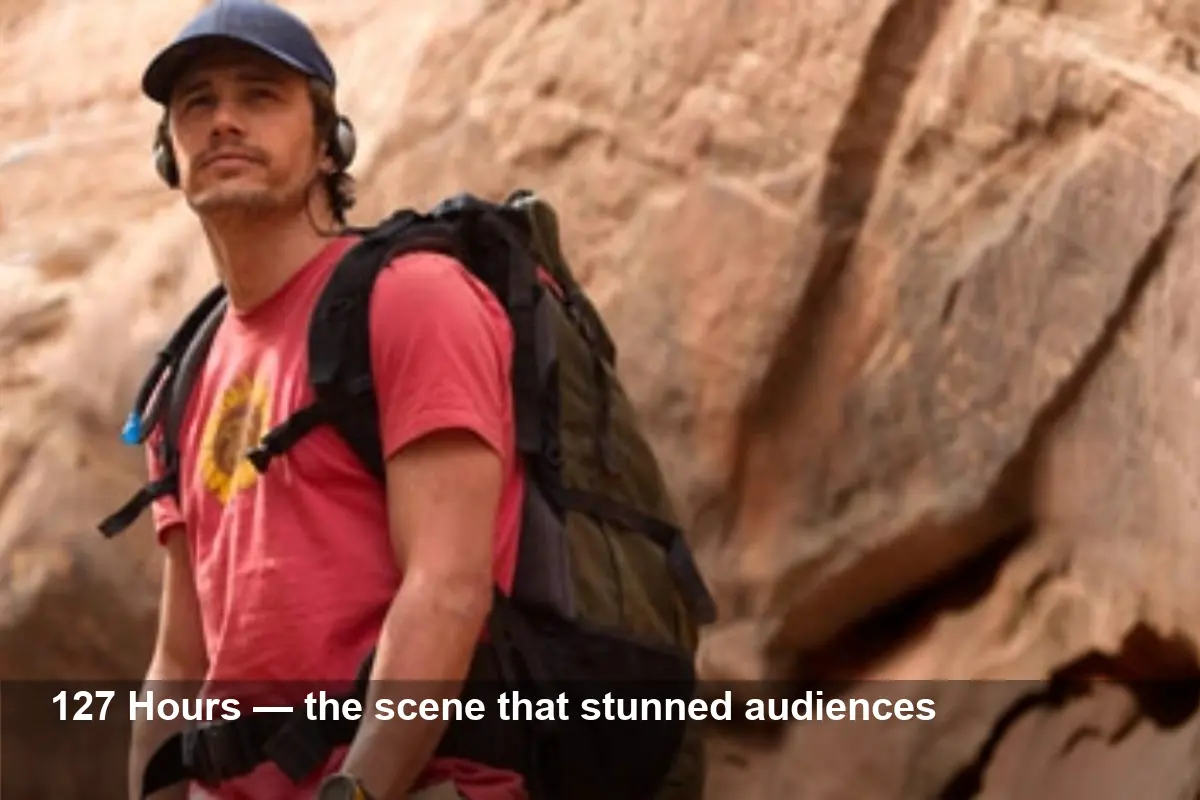
- Danny Boyle’s 2010 survival drama 127 Hours prompted fainting and vomiting at some early screenings.
- The film’s climactic amputation scene (Aron Ralston) tested audience limits while earning critical praise.
- Boyle intended immersion and empathy, not pure shock; the movie holds a 93% Rotten Tomatoes score.
H2: Why 127 Hours left viewers reeling
Few movie moments create the physical reactions 127 Hours did. Directed by Danny Boyle and starring James Franco as real-life climber Aron Ralston, the film follows Ralston after a boulder pins his arm in a remote canyon. The story builds to a single, sustained sequence in which Ralston makes the desperate choice to amputate his own arm with a dull multi-tool.
That scene — visceral, intimate, and relentless — reportedly caused walkouts, fainting and vomiting during early screenings. But the shock came from more than gore: Boyle stages the moment to make viewers feel Ralston’s cramped panic, time dilation, and moral urgency.
H3: Craft, empathy and endurance
Boyle’s approach aimed to immerse audiences rather than simply horrify them. Tight close-ups, inventive camera work and a pulsating sound design place viewers inside the canyon with Franco’s performance. The result is not meant as spectacle for its own sake but as a test of filmmaking empathy: to make audiences confront what survival can demand.
Critics rewarded that commitment. 127 Hours earned strong reviews, sitting near 93% on Rotten Tomatoes, and won praise for Franco’s performance and Boyle’s direction. The film demonstrates how a single, ethically fraught sequence can define a movie’s emotional power without tipping into exploitation.
H4: Boyle’s intent: redemption over shock
In interviews, Boyle described the amputation as a redemptive act in Ralston’s story — a painful but necessary step toward survival and personal reckoning. Within that narrative context, the sequence reads as a triumph of human will rather than a mere provocation.
Audiences’ audible reactions, according to Boyle, signaled that the film had achieved its aim: to communicate stakes so clearly that viewers physically respond. That response places 127 Hours alongside other boundary-testing films — from Boyle’s earlier hits like Trainspotting and 28 Days Later to more extreme works such as Gaspar Noé’s Irréversible — while remaining distinct for its intimate focus.
H5: Where to watch and why it matters now
127 Hours remains a powerful, compact example of survival cinema. Distributed by Fox Searchlight Pictures, it continues to be included on streaming platforms and can be found on services such as HBO Max and Paramount+ depending on region and licensing. For modern viewers, it’s less a shock piece than a case study in how filmmakers balance truth, craft and audience tolerance.
Whether you watch for James Franco’s committed lead, Boyle’s inventive direction, or to test your own limits, 127 Hours invites a strong reaction — and a conversation about how far movies should go when based on true events.
Image Referance: https://3dvf.com/en/neither-trainspotting-nor-28-days-later-this-danny-boyle-film-made-audiences-faint-14-years-ago/