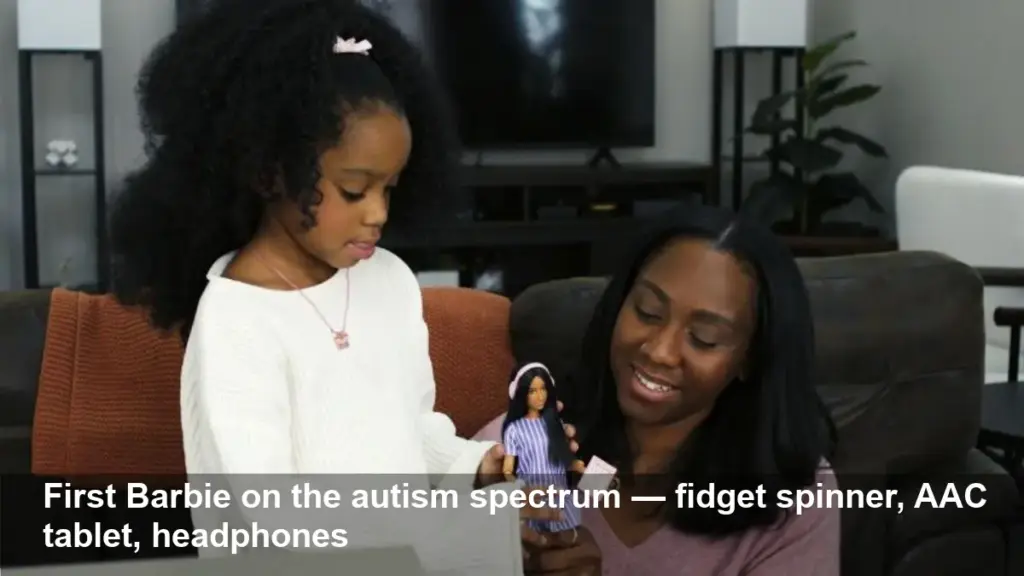
- Mattel has released the first Barbie designed to represent a child on the autism spectrum.
- The doll includes a working pink fidget spinner, noise-cancelling headphones and a pink tablet that represents an AAC device.
- Mattel worked with the Autistic Self Advocacy Network; advocates say the doll offers important representation, especially for girls often underdiagnosed.
First-ever autistic Barbie debuts
Mattel on Monday unveiled a Barbie doll created to represent a child on the autism spectrum. The new Fashionistas doll carries a functional pink fidget spinner, wears pink noise-cancelling headphones and holds a pink tablet meant to represent an augmentative and alternative communication (AAC) device.
Parents and advocates described early reactions as emotional. Precious Hill, a Las Vegas mother whose 5-year-old daughter Mikko is nonverbal and autistic, said her child’s eyes “lit up” when she recognized the familiar tools on the doll. Hill, who learned she is autistic as an adult, told reporters the moment felt “almost magical.”
Embedded post: Precious Hill reacts on YouTube (@thegentlelife) — https://www.youtube.com/@thegentlelife
Design choices reflect real needs
The doll’s design includes details intended to reflect common experiences of some autistic people. Her gaze shifts slightly to the side, nodding to how some people avoid direct eye contact. The dress is loose and short-sleeved to echo sensory preferences for minimal fabric contact. Mattel says these choices were informed by guidance from the Autistic Self Advocacy Network (ASAN).
Colin Killick, executive director of ASAN, said the nonprofit helped advise Mattel during the design process to create an “authentic, joyful representation.” Mattel’s Fashionistas line already includes dolls with diverse body types, skin tones and health conditions — now expanded to include autism alongside examples such as type 1 diabetes, Down syndrome and blindness.
Why representation matters
Advocates emphasize that toys can shape how children see themselves and others. Research and community voices point out that autism is frequently underdiagnosed in girls; visibility in a mainstream toy like Barbie can open conversations and reduce stigma.
The new doll also highlights tools that support independence. An AAC device helps people who are nonverbal or have speech differences communicate. Fidget items and noise-reducing headphones can help manage sensory overload — common strategies some autistic people use.
A single doll, many reactions
Community leaders stress that autism is a broad spectrum and no single doll can represent every experience. Some families praised the doll for normalizing adaptive tools, while others noted the diversity of needs across the spectrum.
Mattel and ASAN said the doll aims to represent roughly the number of US children diagnosed with autism — about 1 in 31 by age 8, according to CDC figures cited by Mattel. The company says the release is part of ongoing efforts to expand inclusive toys.
The launch has prompted positive attention from parents, advocates and autism organizations, who say mainstream representation — when created in collaboration with autistic people — can help children feel seen and spark important conversations about disability, difference and inclusion.
Image Referance: https://www.cnn.com/2026/01/12/health/autism-barbie-doll-wellness
