
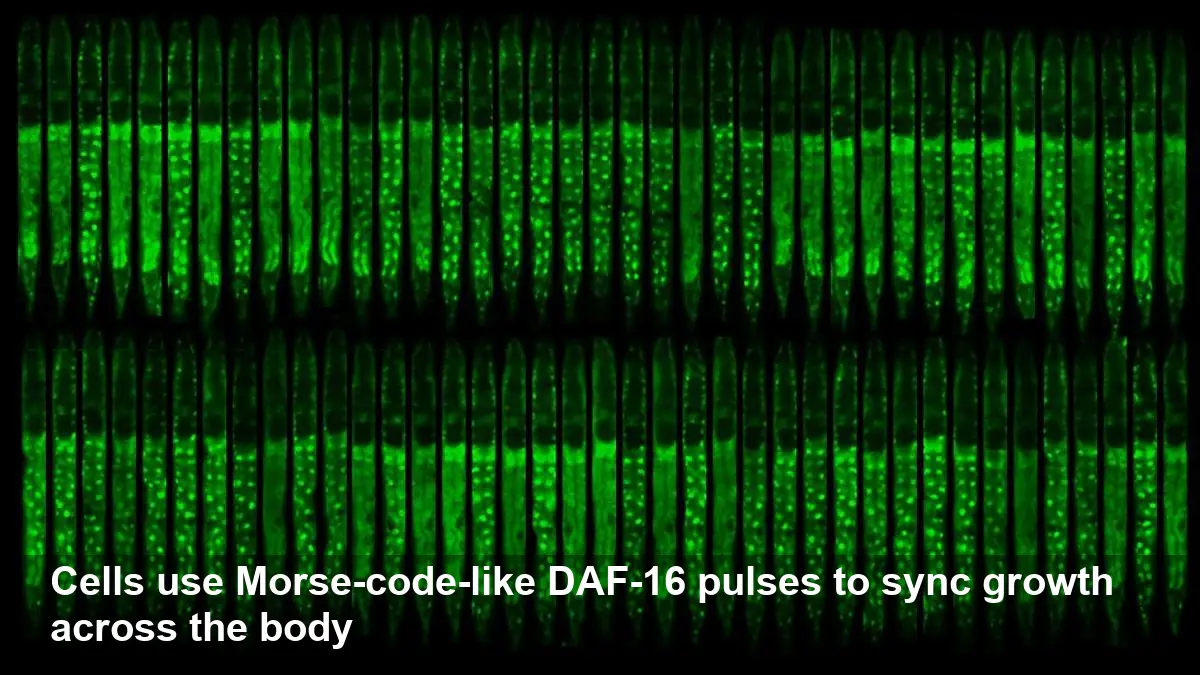
- Cells send DAF-16 pulses into nuclei with rhythm patterns that signal stress type and amount.
- All somatic cells synchronize these pulses, so the worm stops and resumes growth together.
- Starvation produces regular oscillations; salt causes irregular pulses whose frequency rises with stress.
- The worm protein DAF-16 is the equivalent of human FOXO, linking findings to diabetes, cancer and aging research.
Morse code-like rhythms carry stress information
Researchers at AMOLF found that the insulin-regulated protein DAF-16 moves into and out of cell nuclei in C. elegans in distinct rhythmic patterns. By tracking fluorescently labeled DAF-16, the team observed that different stresses produce different temporal signatures: starvation produced regular oscillations, while increasing salt stress produced more random, higher-frequency pulses. The scientists describe these patterns as a Morse code-like language cells use to convey both the type and intensity of stress.
All cells pulse together
Unexpectedly, DAF-16 translocation events occurred simultaneously across all body cells. That synchrony proved critical: when DAF-16 entered nuclei, larvae stopped growing; when it exited, growth resumed. AMOLF Ph.D. student Burak Demirbas noted, “as soon as DAF-16 moves into the nucleus, the larva stops growing, and as soon as the protein has left the nucleus, it starts growing again.” The coordinated pulses ensure the entire organism halts or resumes growth in unison, preserving correct body proportions.
How rhythms encode stress and growth decisions
The researchers measured both pulse duration and frequency and found that specific combinations encoded different stress conditions. For example, a steady oscillation signaled nutrient deprivation, prompting a conserved stress-response program. Variable, rapid pulses signaled osmotic stress from salt, with pulse frequency scaling with salt concentration. In this way, temporal patterns of nuclear localization provide a compact code for signaling pathways to trigger tailored genetic responses.
Implications for human health
DAF-16 is the worm ortholog of the human FOXO family of transcription factors, which work with insulin signaling to regulate growth, stress resistance and aging. Because FOXO proteins play roles in diabetes, cancer and longevity, the discovery that timing and whole-body synchronization matter adds a new layer to understanding how signaling dynamics influence physiology and disease. The AMOLF team published their results in Nature Communications (Demirbas et al., 2025; DOI: 10.1038/s41467-025-66164-2).
What’s next
Future research will test how tissues coordinate pulses and whether similar synchronized rhythms exist in more complex animals. If timing-based codes operate in mammals, they could reveal new therapeutic angles: manipulating pulse frequency or synchrony might alter growth, stress responses or disease progression.
These findings show that cells don’t only use chemical concentration and localization to communicate—they also use timing. Like Morse code, the rhythm itself can be the message that determines how an organism responds to its environment.
Image Referance: https://phys.org/news/2026-01-cells-morse-code-rhythms-growth.html