
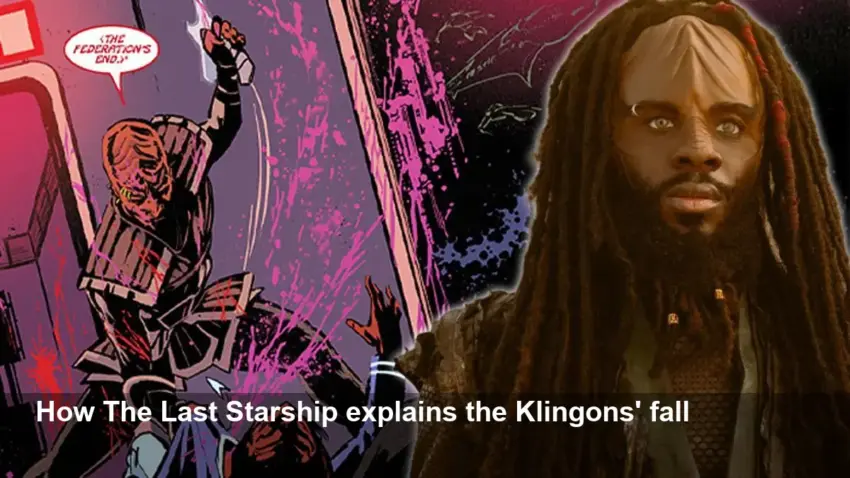
- IDW’s Star Trek: The Last Starship comic explores how the Klingon Empire collapsed after The Burn.
- Captain Delacourt Sato and the USS Omega repel a Klingon “Black Fleet” attack on Earth.
- Sato’s actions send Klingon worlds into catastrophic detonations, creating refugees later seen in Starfleet Academy.
- Licensed comics coordinate with Paramount but are not strictly canon; the tie-in Starfleet Academy comic arrives in April.
New comic fills gaps in 32nd-century Klingon history
IDW’s new flagship series, Star Trek: The Last Starship, offers a grim account of what happened to the Klingons in the immediate aftermath of The Burn — the catastrophic event first shown in Star Trek: Discovery. Set roughly a century before Starfleet Academy’s timeline, the first arc shows how the Klingons moved from a proud empire to a scattered, near‑extinct people.
The Black Path and a brutal attack on Earth
The story centers on the USS Omega, a hastily built Starfleet vessel powered by a recovered Borg transwarp drive and commanded by Captain Delacourt Sato. When a militant Klingon named Ha’shet leads a cult called the Black Path, her fleet launches surprise attacks on Earth, dropping warp cores as antimatter bombs that devastate major cities.
Sato teams up with a resurrected James T. Kirk and fights the Black Fleet. The comic punctuates Klingon rhetoric with lines like, “In the burning detonations across the stars…,” and shows the brutal tactics the Black Path uses to justify war against the Federation.
Sato’s controversial solution
After defeating the Black Fleet in battle, Captain Sato does something unexpected and dark: he declares himself commander of the Klingon survivors and orders them home. In a captain’s log that the comic itself compares to moments that would have stunned Benjamin Sisko (Avery Brooks), Sato records what follows:
“They go into the darkness on my order. Back to their warrior halls and ancient battlefields. Soon, the screaming starts. Twenty‑nine Klingon worlds light up with dilithium detonations, their last transmission is a roar in a thousand voices. And then they’re just gone.”
That passage suggests Sato authorized or enabled widescale destruction on Klingon homeworlds — a grim explanation for why, a century later in Starfleet Academy, Klingons appear as refugees and near‑stateless.
How this ties to Starfleet Academy
Starfleet Academy’s recent episode “Vox in Excelso” showed Klingons scattered and nearly extinct, later given a new home on Faan Alpha. While the series did not reference the specific events from The Last Starship, the comic’s arc offers a plausible chain of events: Klingon worlds destroyed after Sato’s orders, leaving survivors who would become refugees until a future solution emerged.
IDW coordinates its licensed comics with Paramount to keep continuity consistent, but comics remain officially non‑canonical. Still, The Last Starship fills narrative holes and enriches the 32nd‑century setting.
What’s next for Trek comics
IDW will publish the first direct Starfleet Academy tie‑in comic, Star Trek Starfleet Academy: Lost Contact, on April 28. The five‑issue miniseries will follow cadets stranded on a low‑oxygen world and is billed as a first‑contact survival story. Fans can order print copies at local comic shops or buy digital editions on platforms like Amazon/comiXology.
For viewers who want more context on the Klingons’ fall and what led to their refugee status in Starfleet Academy, The Last Starship provides a bleak — and compelling — explanation.
Image Referance: https://trekmovie.com/2026/02/03/new-star-trek-comic-reveals-the-dark-history-of-the-klingons-before-starfleet-academy/